
Doing Less to Achieve More in Your Career: How Focused Action Leads to Growth
A powerful reflection on breaking busy culture, choosing mindful productivity, and building sustainable career growth without burnout.

Last week, I had a moment that landed harder than I expected.
It was 7:45 a.m. on a Tuesday. My calendar was already stacked back-to-back. I hadn’t even made coffee yet. And there I was, staring at a blinking cursor in the middle of a half-written email, feeling oddly exposed by it. Like the screen was mirroring back exactly how I felt.
Drained. Already.
The day hadn’t even started.
Sound familiar?
I remember sitting there thinking, honestly, how did we get here? When did we start treating constant busyness like a badge of honor? When did career focus quietly turn into a nonstop sprint, where frenzy somehow equals value?
Why Are We Still Equating Output With Worth?
Somewhere along the way, productivity began masquerading as purpose. Motion became more important than meaning. We confuse activity with impact and quantity with quality, even when deep down we know better.
It’s not unusual anymore to hear someone proudly say they’re slammed or running on fumes. As if exhaustion proves importance. As if overwhelm is the price of ambition.
But here’s the thing. Doing more doesn’t automatically lead to achieving more. Sometimes it leads to less. Less clarity. Less creativity. Less energy for the work that actually matters.
I’ve learned this the hard way.
We get so busy producing that we forget to stop and ask a basic but uncomfortable question: is any of this actually moving the needle?
This confusion between busyness and impact is one of the biggest drivers of burnout, especially for high-achieving professionals. Research in occupational psychology backs this up. Overcommitting without strategic focus leads to decision fatigue, lower-quality work, and diminished creativity. We spend more energy and get less in return.
If you’re looking for career growth without burning yourself out, the answer usually isn’t more effort. It’s better direction. Focused action. Fewer, clearer priorities.
That shift changed everything for me.
And it came into focus during a conversation that had nothing to do with work.
I was talking to a friend who’s training for her first marathon. She told me, very matter-of-factly, that she’s not the fastest. She doesn’t run the longest distances. She struggles on hills and still has days she wants to quit.
But she shows up.
Every morning. No drama. No perfection. Just consistency.
That stuck with me.
Maybe progress doesn’t come from sprinting every day. Maybe it comes from showing up steadily, even when it feels unremarkable. Maybe slow, steady career growth looks a lot more like presence than performance.
Think about your own career for a moment. You don’t need to sprint every single day to move forward. You need a marathon strategy. Small, consistent actions aligned with long-term goals. The kind that compound quietly over time.
In coaching circles, this is called strategic consistency. I think of it as professional trust. Doing the right things often enough that they become second nature.
Just Showing Up Might Be the Whole Game
What if the real magic isn’t in how much you do, but in whether you show up at all?
So many of us wait for the perfect conditions. The right mood to write that proposal. The confidence to reach out to someone we admire. The imaginary moment when we finally feel ready.
But those moments are rare. And waiting for them quietly keeps us stuck.
Here’s what I’ve learned. Confidence doesn’t come first. Action does.
Consistency builds confidence, not the other way around. Showing up, especially when it’s inconvenient or uncomfortable, is an act of quiet self-trust. It’s saying, I’m here. Even if it’s messy. Even if I’m not sure yet.
Neuroscience supports this too. Studies on habit formation show that action precedes motivation far more often than motivation precedes action. Momentum is created by starting, not waiting.
In fast-paced careers, this matters. You don’t wait for ideal conditions. You create them by showing up daily and practicing mindful productivity. Progress without depletion. Effort without exhaustion.
What If Slowing Down Feels Like Falling Behind?
This is where things get tricky.
We live inside systems that reward urgency. Immediate replies. Full calendars. Constant availability. Slowing down can feel risky, even dangerous. Like you’re opting out of ambition.
You worry you’ll be seen as less committed. You wonder if opportunities will pass you by. You tell yourself, if I just push a little harder, maybe I’ll finally catch up.
I’ve been there.
I’ve checked every box and still felt behind. I’ve worked late and gone to bed with that heavy feeling that I didn’t do enough. That no matter how much I gave, it was never quite sufficient.
But here’s the uncomfortable truth. Constant catch-up is part of the problem. Trying to do everything spreads you thin until nothing feels solid anymore.
This is where boundary-setting becomes a career skill, not a personality trait. Slowing down strategically allows you to focus on high-value work with full presence. It doesn’t make you less capable. It makes you more effective.
The professionals who protect their mental bandwidth tend to be the ones producing the most thoughtful, innovative work over time. Not because they do more. Because they do what matters, well.

The Importance of Setting Boundaries in a Busy Work Culture
Setting boundaries used to feel selfish to me. Now it feels necessary.
In a culture that celebrates being always on, boundaries are a form of self-respect and smart career management. Protecting your time, energy, and attention is not a weakness. It’s a requirement for sustained contribution.
High performers often share this quietly. They say no more than people realize. They guard their deep work time. They understand that focus is fragile.
If you’re worried about setting boundaries without damaging your reputation, start small. Communicate clearly. Share your deep work hours. Turn off non-essential notifications when you need to think. Decline projects that don’t align with your priorities.
These choices send a signal. Not that you’re unavailable, but that you value your work enough to protect the conditions that allow it to be good.
Over time, this builds a reputation rooted in quality, not chaos.
Focus on Fewer, Truer Things
Lately, I’ve been asking myself one simple question at the start of the day.
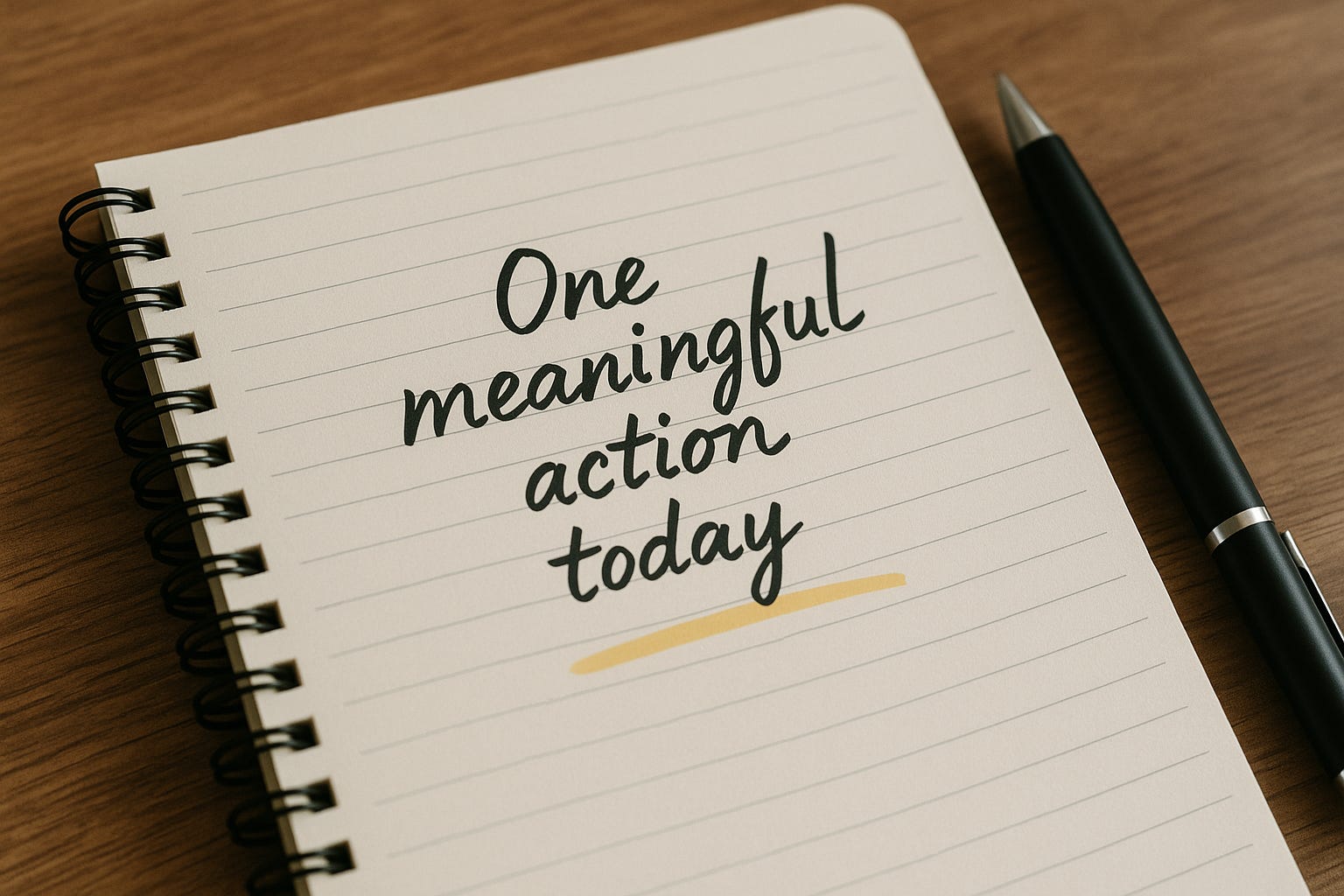
What’s the one meaningful action that could move the needle today?
Not the twelve urgent tasks. Not the inbox-zero fantasy. Just one thing that actually matters.
Some days, it means saying no to a meeting. Other days, it’s thirty focused minutes on a project that’s been buried under busywork. Sometimes, it’s resting so I can think clearly tomorrow.
It’s not flashy. It doesn’t look impressive from the outside. But it feels honest. And that matters more than we’re taught to admit.
How to Identify Your Highest-Impact Tasks at Work
Focusing on what matters requires clarity. You have to decide what actually drives progress in your career, not just what fills your time.
Tools like time-blocking or prioritization frameworks can help, but the real shift is mental. Plan your day around impact, not urgency. Protect uninterrupted time for your most meaningful work.
Some people create a short career impact list. A living document that tracks the projects, relationships, and skills most tied to their long-term growth. Revisit it weekly. Use it as a compass when everything starts feeling loud.
If a task doesn’t connect back to that list, it deserves a second look.

Tools and Strategies for Managing Distractions in a Digital Workplace
Distractions are no longer accidental. They’re built into how we work.
Slack messages. Email threads. Back-to-back video calls. Managing them isn’t about willpower. It’s about design.
Schedule no-meeting blocks.
Silence non-essential notifications.
Use focus tools if they help.
Practice digital minimalism.
Keep the tools that support your goals. Let go of the rest.
Every interruption costs more energy than we realize. Protecting your attention protects your work.
How I’m Practicing This Now, After Over 20 Years in the Corporate World
I block time for deep work, even when it’s uncomfortable. One focused hour consistently outperforms four hours of reactive scrambling.
I no longer measure success by how full my calendar looks. I ask different questions now. Did I move something meaningful forward? Did I protect my energy?
I celebrate small, steady effort. Like writing a little each day. Like my friend running her marathon miles slowly but consistently.
And I take real breaks. Not scrolling breaks. Actual pauses. Breathing. Stepping away. Remembering that I’m human, not a machine.
The Hustle Hangover
Many of us inherited a story that says ambition equals exhaustion. That grinding is proof you care. That rest is something you earn later.
But more and more people are questioning that story.
Burnout isn’t a badge. It’s a warning. Rest isn’t laziness. It’s strategy. Less isn’t less. It’s focus.
The rise of remote work, four-day weeks, and open conversations about mental health shows that something is shifting. Slowly, yes. But meaningfully.
The Role of Mental Health Awareness in Modern Career Success
Mental health is no longer a side conversation. It’s central to sustainable success.
Mindfulness, counseling, flexible schedules, and realistic expectations are changing how we define achievement. Especially for women, the ability to pursue ambition while protecting well-being is becoming the new standard.
This isn’t about lowering the bar. It’s about making success livable.
Letting Go of the Scoreboard
One of the biggest changes I’ve made is letting go of the invisible scoreboard.
The constant comparison. The pressure to prove. The belief that every moment must be optimized.
Now, I measure progress differently.
By energy. By alignment. By peace.
Am I grounded in my work? Am I proud of how I’m showing up? Am I doing what actually matters?
That’s my scorecard now.
A Line That Sticks
You don’t need to do everything. You just need to keep showing up for what matters the most on that day.
When we let go of doing it all, we make space to do the right things well.
Why Mindful Presence Beats Multitasking for Career Growth
Multitasking feels productive. It isn’t.
Research consistently shows it reduces quality and increases stress. Mindful presence, on the other hand, builds deeper focus, stronger decisions, and more creative work.
Even one hour a day spent fully present on your highest-priority task can change the trajectory of your work. Over time, it becomes a quiet advantage. The kind that compounds.
A Question for You
What would change if you did less, but did it with full presence and care?
Could doing less actually open the door to more meaning, deeper impact, and a greater sense of ease?
You don’t need to overhaul everything. Just start with one focused step. And then another. That’s how real growth happens.
Thank you for reading and reflecting alongside me. Alex
This is a really wonderful article, Alex. I hope many will read it and be inspired to do less with greater impact and clarity.
What if the real magic isn’t in how much you do, but in whether you show up at all?
This is true in so many things. It's the mere act of showing up