
Progress Without Losing Peace: Two Perspectives on Growth
A reflective dialogue on ambition, contentment, defining enough, and how to grow without burnout.


There are many ways to grow.
Some move forward through structure - clear systems, measured steps, steady discipline.
Others move through reflection - pauses, recalibration, listening inward before acting.
Alexandra Pasareanu founder of Wisdom Library writes about wisdom, presence, alignment, embodiment, and inner truth.
Ryan founder of Present and Progressing writes about clarity, systems, discipline, and sustainable ambition.
We realized we write from different perspectives. And instead of debating which approach is right, we became curious.
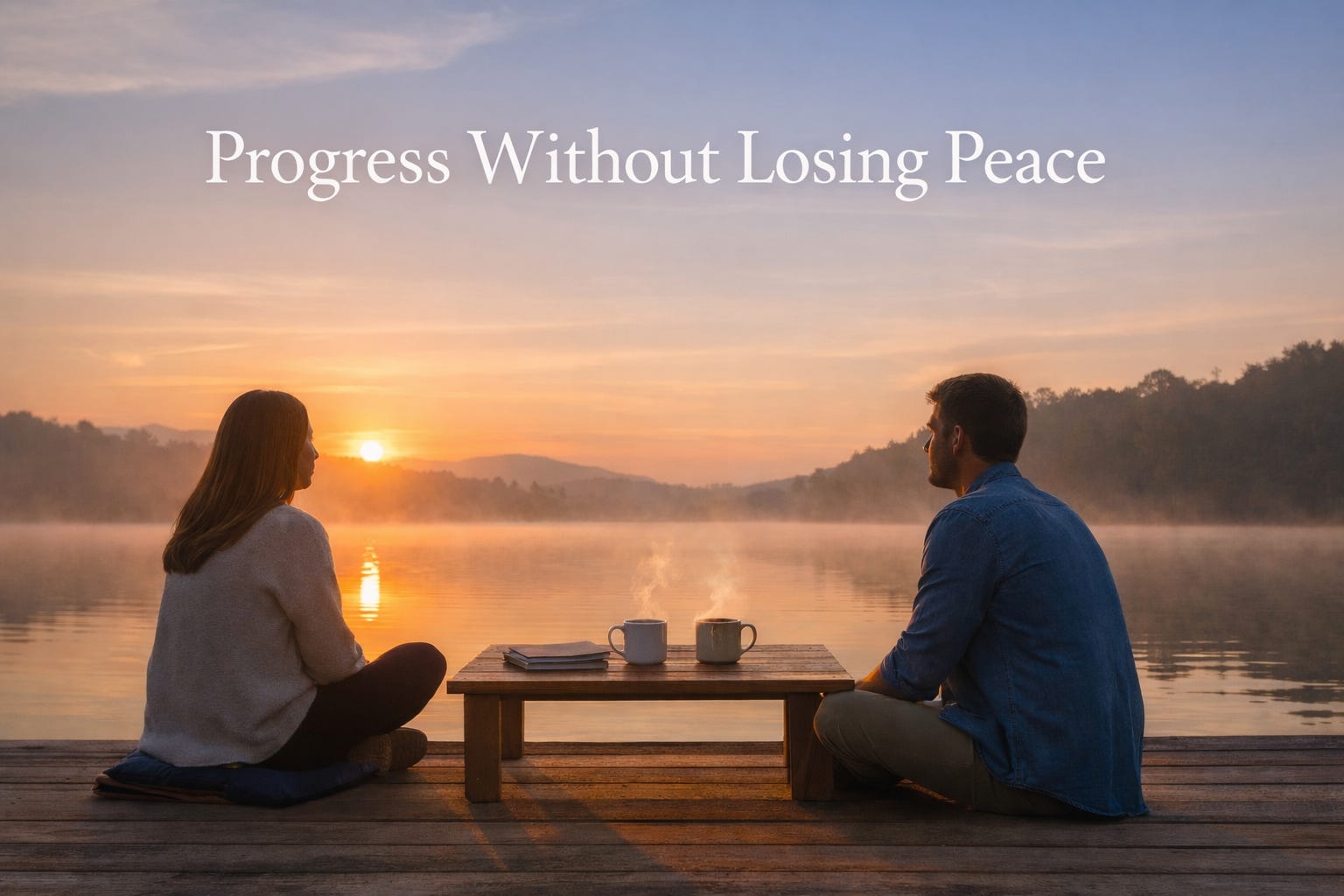
What happens when these two ways of growing sit at the same table?
Can ambition coexist with contentment?
Can progress unfold without pressure?
The share of Alexandra Pasareanu and Ryan‘s experience below is an attempt to explore those questions honestly - not to draw a line between philosophies, but to see where they overlap. To understand how structure and stillness might not compete, but complement.
We’re writing this together because growth itself is rarely one voice. It is tension. It is contrast. It is the quiet space between discipline and intuition. And maybe the real work isn’t choosing sides - but learning to hold both.
1. How do you know when growth becomes restlessness?
“I’ve had seasons where growth felt energizing, almost sacred. And I’ve had seasons where it felt tight and urgent - like I was running toward something without ever arriving. That’s how I know I’ve crossed the line.
The shift is subtle. I start waking up already measuring the day. Already asking what needs to be improved. My language moves from curiosity to correction. From “What feels aligned?” to “What’s next?” before I’ve even lived what’s here.
I remember a period in my corporate career at the Big 4 when everything looked like expansion - promotions, larger teams, bigger projects. On paper, it was progress. But one evening, sitting alone in the quiet office, I felt none of it. My chest was tight. I was already chasing the next milestone instead of absorbing the one I had reached.
That was the tell.
Growth expands you. Even when it stretches you, there is steadiness underneath. Restlessness shrinks you. It turns ambition into proof.
Ambition isn’t the problem. I’m ambitious. The problem begins when “better” becomes a condition for self-acceptance. When I feel I must chase another version of myself in order to be enough.
That’s when growth becomes rejection instead of vision.
Now, when I feel that tightness, I pause and ask myself one question: Am I moving from clarity, or from fear?
The answer always reveals the difference.”
“Growth becomes restlessness when forward motion isn’t connected to a clear why.
Early in your career, I’m a big advocate of saying yes. Saying yes to opportunities naturally creates more opportunities. It expands your network, your skill set, and your perspective. But there comes a point where you can overleverage yourself. And that’s when growth quietly turns into stress, burnout, and anxiety.
I experienced that during my graduate year of college. I was completing my master’s degree in one year, recruiting for a collegiate rowing team, creating and teaching the largest class at the college, interning at a Fortune 100 company, and maintaining a daily fitness streak. On paper, it looked like progress. But my energy was spread thin. I was doing a lot, but not all of it was connected to a clear direction anymore.
I had said yes so much that I stopped asking why. Eventually, I had to eliminate things. I gave up the internship. I made sure I had a job lined up before leaving, but then I took time off to finish what truly mattered.
That reset wasn’t quitting. It was realignment. Growth is powerful. But if you’re constantly moving without checking whether the direction still fits your values and capacity, that movement becomes restlessness.
Saying yes is good. Saying yes without awareness isn’t.”
2. Can you be content and ambitious at the same time?
“I used to believe ambition needed a little dissatisfaction to survive. That if I became too content, I would lose my edge. There was a quiet fear that peace would make me complacent.
In 2014, while studying under Jack Canfield, I was immersed in big goals and structured action plans. I loved the clarity of it. At the same time, I was deepening my yoga and meditation practice. My mornings were slow. Grounded. Present. For a while, those worlds felt separate - ambition during the day, stillness in the morning.
But something shifted.
On the days I was consistent with meditation, my ambition didn’t disappear. It became cleaner. I wasn’t chasing goals to validate myself. I wasn’t proving anything. I simply wanted to express something that already felt alive in me.
That’s when I understood the difference.
Ambition fueled by dissatisfaction feels compensatory. You build because you think something is missing. Ambition rooted in contentment feels creative. You build because something inside you wants to expand.
Contentment doesn’t dull ambition. It stabilizes it. It replaces “I need more to be okay” with “I am okay, and I’m curious about what’s possible.”
So yes, I believe you can be deeply content and deeply ambitious at the same time. But the ambition has to grow from wholeness, not from lack. Otherwise, you’re not creating - you’re compensating.”
“I think it’s all a balancing act, and for me, the healthiest version of ambition is rooted in awareness and gratitude. You can be thankful for where you are while still striving for more.
The tension only becomes unhealthy when ambition is fueled by dissatisfaction rather than direction.
I don’t think growth is purely monetary. If ambition is only about income, status, or accumulation, it can quietly consume you. But if growth is about impact - how many people you can help, how many lives you can influence, whether you can bring people together - then ambition becomes expansive.
That said, when it comes to finances and material goals, you do need a definition of enough. If you never define enough, ambition has no boundary. And without boundaries, it can erode gratitude.
So yes, I believe contentment and ambition can coexist. But only when ambition is anchored in values, not comparison, and when you consciously decide what “enough” means for you.”
3. Who would you be if you stopped trying to “improve” yourself?
“This question makes me pause every time.
If I stripped away the routines, the goals, the constant refinement - who am I beneath all of that?
I’ve spent years studying mindset, neuroscience, manifestation, personal growth. Improvement became part of my identity. The seeker. The learner. The one who is always evolving. And while that sounds admirable, there is a quiet pressure hidden inside it.
I remember during my yoga teacher training, we had a long silent practice - just breath and movement. No tracking. No optimizing. At one point, I asked myself, “If I never improve another thing, who am I right now?”
The answer surprised me.
I was present. Caring. Thoughtful. Aware. None of that depended on constant self-upgrade.
That experience softened something in me. Growth is beautiful. But it is not a personality. When it becomes something we perform to feel worthy, it loses its grounding.
When I loosen my grip on constant improvement, I don’t stagnate. I actually become steadier. I listen more. I make choices that feel aligned rather than impressive.
Maybe growth isn’t something we need to force. Maybe it unfolds naturally when we stop trying to earn our worth through it.
And maybe beneath all the striving, there is already someone who is always enough.”
“I’ve honestly never thought about that before.
I feel like I’ve been wired to grow. Not improvement for improvement’s sake, not chasing perfection, but growth in the sense of expansion.
Learning. Understanding more. Becoming more aware of the world and my place init.
I don’t see growth as fixing something broken. I see it as engaging fully with being human. As long as I’m alive, I want to be learning about relationships, about my mind, about how to contribute meaningfully.
That’s not self-rejection. That’s curiosity. If I stopped trying to “improve,” I think I would still grow, just in quieter ways.
Growth doesn’t always have to be visible or measurable. It can look like deeper conversations. Better listening. More patience. A wider perspective.
For me, the goal isn’t constant optimization. It’s holistic growth. And that feels less like pressure and more like participation in life.”
4. What does “enough” look like in your own life?
“For me, enough is rarely a number. It’s a feeling in my body. It feels like exhaling.
There was a time when enough meant external markers - a certain salary, a leadership title, recognition that confirmed I was doing well. But those markers move. You reach one, and another quietly appears. The horizon never really settles.
Over time, my definition changed.
Now, enough looks like leading my team with clarity and still having emotional energy at the end of the day. It looks like handling complex projects without carrying that tension home in my body. It’s closing my laptop and not replaying every decision in my head.
Enough feels like enjoying dinner without drafting tomorrow’s to-do list. Like choosing a slower walk instead of one more task. Like saying no to something impressive because it’s misaligned. There is freedom in that.
For me, enough is clarity. It’s knowing why I’m doing something and trusting that I don’t need to do everything. It’s being at peace with myself from different angles - professionally, emotionally, spiritually. Not perfect. Just steady.
What surprised me is that defining enough didn’t slow my progress. It sharpened it. When I know what enough means, I stop chasing endlessly. I choose more intentionally. I lead with more calm.
Enough changes with seasons. But I revisit it on purpose. Because if I don’t define enough for myself, the world will define it for me. And that version is usually louder, faster, and never quite satisfied.
Enough isn’t settling. It’s anchoring. And from that anchor, progress becomes focused instead of frantic.”
“I’m still learning what “enough” means for me.
I’m 26. I have a lot of life ahead of me. I think it would be a disservice to myself to throw my hands up and say, “I made it. This is enough forever.”
But right now, enough looks like the intentional use of my time and energy. Enough is knowing that my days reflect what I say matters: family, relationships, financial wellness, health, learning, helping others. If I’m allocating my energy toward those things with intention, that feels like enough.
That doesn’t mean I stop growing in those areas. I’m still building financially. I’m still strengthening relationships. I’m still learning. The difference is that growth isn’t replacing gratitude. It’s happening inside of it.
For me, “enough” isn’t a fixed number. It’s a posture. It’s the decision to move forward without abandoning appreciation for what already exists.”
5. Does peace come after achievement, or before it?
“I think many of us believe peace is waiting on the other side of achievement. “Once I reach that milestone. Once I earn that role. Then I’ll relax.”
I believed that for years.
The problem is that peace built on outcomes is fragile. The goalpost moves. The next milestone appears. And if your nervous system is always bracing for what’s next, rest never actually arrives.
I saw this clearly around 2019, when I became certified as a Law of Attraction Mindset Coach. I was studying how inner state shapes outer results. At first it felt like theory. Then I started noticing it in my own decisions.
When I acted from urgency or subtle scarcity, even successful outcomes felt heavy. My body was tight. The achievement didn’t bring relief. It just led to the next thing.
But when I slowed down, reflected, and made decisions from grounded clarity, something shifted. The path felt cleaner. My effort felt aligned, not forced. Some of my biggest professional expansions came during periods when I felt internally steady, not desperate.
That’s when I understood something simple.
Peace is not a reward. It is a foundation.
When peace comes first, achievement becomes sustainable. You’re no longer building to prove yourself. You’re building because it aligns.
For me, peace is the atmosphere where healthy progress grows. Ambitious, yes. Expansive, yes. But not frantic.
And that’s a balance I am still learning to protect.”
“For a long time, I believed peace was waiting at the finish line.
Land the opportunity. Hit the number. Win the race. Cross the milestone. Then you’ll feel secure. Then you’ll feel proud. Then you’ll feel settled.
But what I’ve learned, through academics, athletics, career milestones, and financial goals, is that the emotional payoff rarely matches the expectation.
The moment arrives, and it’s often quieter than imagined. And then the next goal appears. If peace depends on achievement, it becomes fragile. It moves every time the goalpost moves.
The most sustainable progress in my life hasn’t come from pressure or desperation. It’s come from calm consistency. From knowing who I am independent of the outcome. From valuing the process rather than attaching my identity to the arrival.
So, I don’t think peace is the reward of achievement. I think it’s the foundation for it.
Achievement built on anxiety creates burnout. Achievement built on alignment creates longevity.
And longevity is what actually compounds.”
If this conversation revealed anything, it’s that growth isn’t one-dimensional.
It isn’t only structure. And it isn’t only surrender.
We may approach growth from different angles - one through systems and direction, the other through reflection and alignment - but beneath both is the same intention: to grow without losing ourselves. → Alexandra Pasareanu and Ryan
Progress without peace becomes pressure.
Peace without progress can become stagnation.
But when action is guided by awareness, and ambition is anchored in clarity, something steadier forms. A life that moves forward with intention. A version of success that doesn’t require self-rejection.
You don’t have to choose between being driven and being grounded.
You can define enough.
You can pursue more.
You can move forward without running.
Maybe the real work is learning how to let structure and stillness sit at the same table - not as opposites, but as partners.
Thank you for reading and reflecting alongside me. Alexandra Pasareanu and Ryan
 | A guest post by
|
Thank you for sharing.