
Transform Your Life with Third Eye Meditation & Visualization
A gentle third eye meditation with visualization to calm the mind, align your energy, and focus on one meaningful goal at a time.

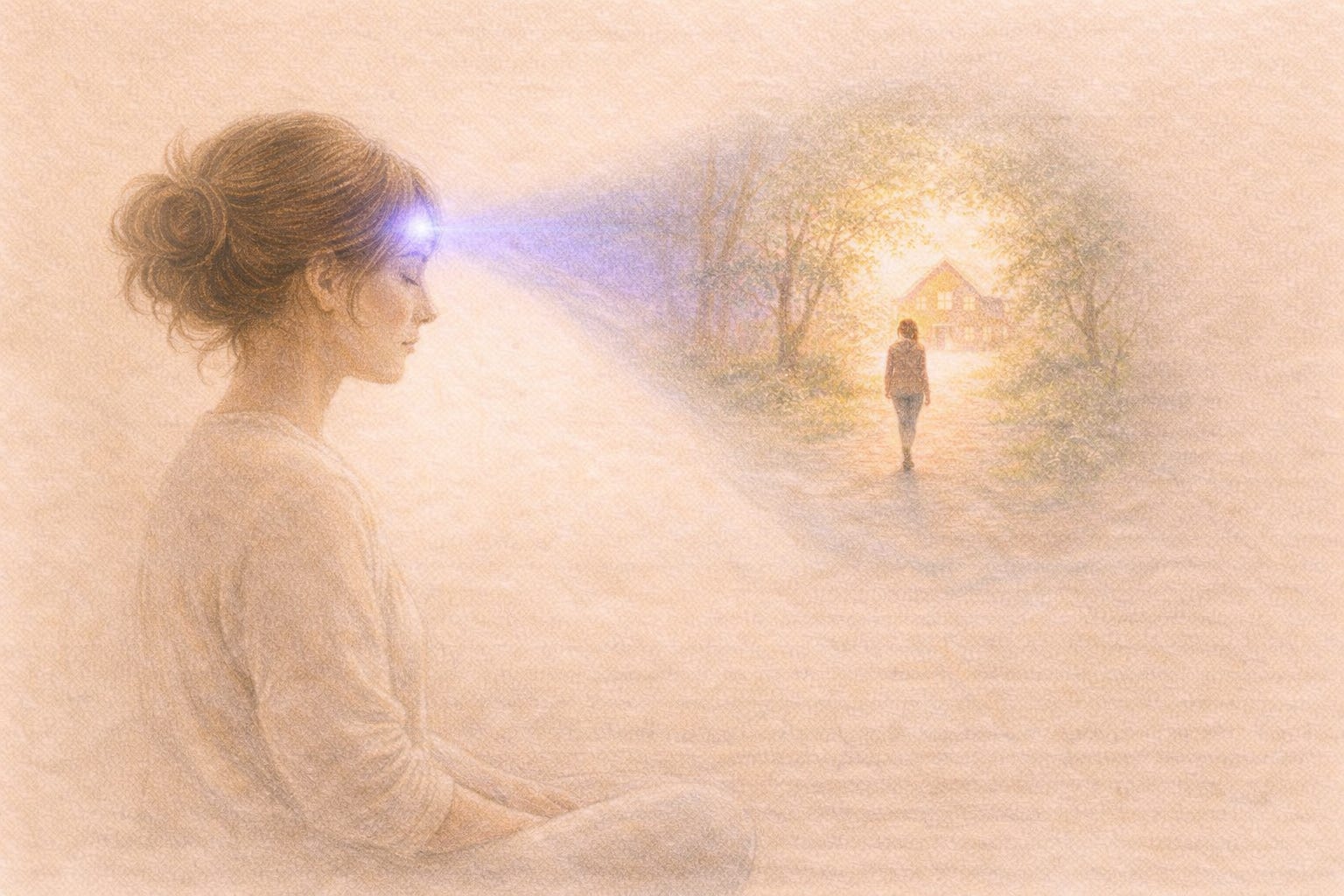
There’s something quietly powerful that happens when you slow down and commit to a daily meditation practice with intention. Not the kind of intention that feels tight or demanding, but the kind that feels steady and curious. Over time, I’ve noticed that the most meaningful shifts in my life - mentally, emotionally, and even physically - didn’t come from pushing harder or trying to fix myself. They came from focusing deeply on less.
From choosing stillness over constant stimulation. From learning how to listen instead of react.
For a long time, I believed progress meant doing more. More effort. More planning. More thinking. But eventually, I hit a point where doing more just made me feel scattered and tired. That’s when I started experimenting with practices that asked me to slow down instead of speed up.
One of the most transformative practices I’ve come to rely on is what I now call Third Eye Meditation with Visualization. It’s a blend of traditional third eye focus and intentional visualization. First, I calm the mind and settle into a relaxed, receptive state. Then, from that quieter place, I visualize a single goal or desired reality with clarity and care.
In simple terms, it’s a bridge between inner stillness and intentional creation.
This is a practice I return to every day, usually in the morning and again in the evening, for about ten to fifteen minutes. It’s subtle. It’s gentle. And honestly, it’s far more effective than it sounds when you first hear about it.
If you stay with me, I’ll walk you through how it works, how I practice it, and why it’s become such a grounding anchor in my daily life.
What Is Third Eye Meditation With Visualization?
At its core, this practice rests on two simple movements inward.
The first is tuning in. I bring my attention to the space between my eyebrows, often referred to as the third eye. This focus naturally quiets mental noise and helps the nervous system settle. I’m not forcing concentration or trying to block thoughts. I’m simply giving my awareness a gentle place to rest.
The second movement happens once that sense of calm arrives. From that settled state, I introduce a single, clear visualization. One goal. One outcome. Not a long list. Not a vague hope. Just one image held with care and consistency.
It’s less about forcing reality to change and more about allowing the mind and body to align with something meaningful.
I often think of it like clearing static from a radio signal. Once the noise quiets, the message comes through clearly.
From a neurological perspective, third eye meditation supports the brain’s shift into alpha brainwave activity. This is a calm but alert state associated with creativity, intuition, and focused awareness. It’s the same state many people drift into just before sleep or during moments of deep creative flow.
When visualization happens from this state, it lands differently. It feels embodied rather than imagined. Believable rather than distant.
Over time, this practice strengthens the bridge between conscious intention and subconscious belief. And that bridge is where lasting change tends to happen.
Practice’s Origin
The idea of the third eye appears across many spiritual, philosophical, and contemplative traditions. In yogic teachings, it’s known as the Ajna chakra, associated with insight, intuition, and inner guidance. In other traditions, it symbolizes perception beyond surface appearances.
Visualization, meanwhile, has a long and surprisingly practical history. Athletes use it to rehearse performance. Musicians use it to prepare for concerts. Therapists use it to help people reframe experiences and build confidence.
What drew me to combining these two approaches was how naturally they fit together.
Third eye focus creates receptivity. Visualization gives direction.
Ancient mystics may have used third eye meditation to explore consciousness, but modern neuroscience has also shown that focused attention and mental imagery can reshape neural pathways. This overlap between ancient wisdom and modern understanding is part of what makes this practice feel both grounded and expansive.
It doesn’t ask you to escape reality. It invites you to participate in it more intentionally.
Benefits Of Third Eye Meditation
Over time, I’ve noticed a wide range of benefits from this practice. Some were obvious. Others revealed themselves slowly.
Mental clarity and less background mental noise
A deeper sense of calm and nervous system regulation
Emotional steadiness during stressful moments
Improved focus on meaningful goals
Enhanced creativity and intuitive problem-solving
A stronger sense of inner alignment
Greater ease when visualizing success
What surprised me most was how practical these benefits felt. This wasn’t about floating away or disconnecting from daily responsibilities. It was about showing up more clearly within them.
Practicing third eye meditation regularly also sharpened my self-awareness. I began noticing patterns earlier. Emotional reactions softened. Decisions felt less reactive and more intentional.
That kind of internal clarity quietly changes everything.

Why Visualization Helps With Goal Achievement
One of the most surprising realizations I’ve had through this practice is how directly it supports real-world progress.
When I consistently visualize a specific goal while in a relaxed, focused state, something shifts. Not just internally, but externally too. Conversations open up. Opportunities appear. My own behavior begins aligning with the outcome, often without conscious effort.
This is where people often talk about the law of attraction, but I prefer to describe it in simpler terms.
When your inner state matches what you’re moving toward, resistance eases.
Visualization isn’t about wishing or hoping. It’s about familiarity. When the mind and body experience something vividly and repeatedly, they begin to treat it as possible. Even achievable.
From that place, confidence grows naturally. Clarity sharpens. Action feels less forced.
When I see a goal clearly in meditation, it stops feeling far away. It becomes part of my internal landscape. And once that happens, my choices begin to reflect it.
That’s the real power here. Not attracting from lack, but moving from alignment.
When To Practice
I practice this meditation twice a day whenever possible.
In the morning, it grounds me before the world rushes in. Before messages, obligations, and noise pull my attention outward, I anchor inward first.
In the evening, it helps me unwind and reconnect with what matters most. It creates a sense of closure and clarity before rest.
If I feel anxious or scattered during the day, I’ll often pause for five minutes and do a shorter version. Even that brief moment of stillness can reset my nervous system.
Consistency matters more than duration. Short, regular sessions build familiarity and trust with the practice.
How Third Eye Meditation Boosts Focus & Calm
There’s a noticeable settling that happens when I focus on the third eye. It doesn’t take long. A few breaths in, my thoughts slow. My body softens. Awareness deepens.
From that place, visualization feels natural rather than forced. Images arise on their own. I’m not straining to imagine them. I’m simply observing and engaging.
This practice doesn’t just calm me. It sharpens my focus. It reminds me of what I’m working toward and why it matters.
Over time, I’ve noticed that as inner clarity grows, outer life responds. Ideas come more easily. Decisions feel cleaner. Stress becomes easier to navigate.
It’s not mystical. It’s alignment.
Step-By-Step: How I Practice Third Eye Meditation With Visualization
Here’s exactly how I move through the practice.
1. Settle In
I choose a quiet space and sit or lie down comfortably. Comfort matters, but I avoid positions that make me sleepy.
2. Close My Eyes
I gently close my eyes and let my awareness rest behind them.
3. Focus On The Third Eye
I bring attention to the space between my eyebrows. No force. Just steady awareness.
4. Breathe Naturally
I allow the breath to flow without control, letting the body relax.
5. Feel The Shift
Within moments, there’s a subtle change. Thoughts slow. Awareness deepens. This is the alpha state.
6. Project A Single Goal
I bring one clear goal into focus. Only one.
7. Build The Image
I add sensory detail. Colour. Emotion. Environment. I imagine myself inside the scene, not observing from afar.
8. Stay With It
I remain with the image gently and steadily. No analysis. No forcing. Just presence.
If you’re new to this, guided meditations can help at first. Over time, the process becomes intuitive.

Third Eye Focus For Intentional Manifestation
What I appreciate most about this practice is its simplicity.
It’s not about chasing outcomes or controlling the future. It’s about aligning with a version of it so clearly that it begins shaping the present.
By focusing on one goal at a time, the mind learns to conserve energy instead of scattering it. That clarity extends beyond meditation into daily life.
Priorities sharpen. Boundaries strengthen. Decisions feel more intentional.
You stop pushing. You start aligning.
Example Of Using It In Real Life
Not long ago, I felt stuck on a personal project. I cared deeply about it, but I was overthinking every step. Motivation dipped. Doubt crept in.
So I brought it into this practice.
Each morning, I visualized the project completed. Not the obstacles. Not the effort. Just the finished reality and how it felt.
Within a week, something shifted. Clarity returned. Momentum followed. Support appeared.
Within a month, the project was complete.
That experience reinforced something important for me. When inner clarity returns, outer movement follows.
Want To Try It?
If this practice feels unfamiliar, start gently. There’s no right way. Just show up and allow your mind to settle.
I’ve shared more guidance in my article Third Eye Meditation For Inner Stillness, which may help you ease into the practice.
A Final Question For You
If you could hold one clear image in your mind today, one meaningful direction or goal, what would it be?
Try sitting with it in your next meditation. Just one image. One focus.
And see what begins to shift.
Thank you for taking the time to read and reflect with me.
If you found this article meaningful or useful, I’d truly appreciate it if you could share it. It helps to spread more wisdom in the world.
Thank you for this wonderful clarity on a useful practice that is often misunderstood! ❤️
Beautiful ❤️