

When The Reaction Becomes The Real Problem
Sometimes the real damage isn’t the problem - it’s how we react to it. A reflection on pausing, responding, and growing through difficult moments.

"Between stimulus and response there is a space. In that space is our power to choose our response." - Viktor Frankl
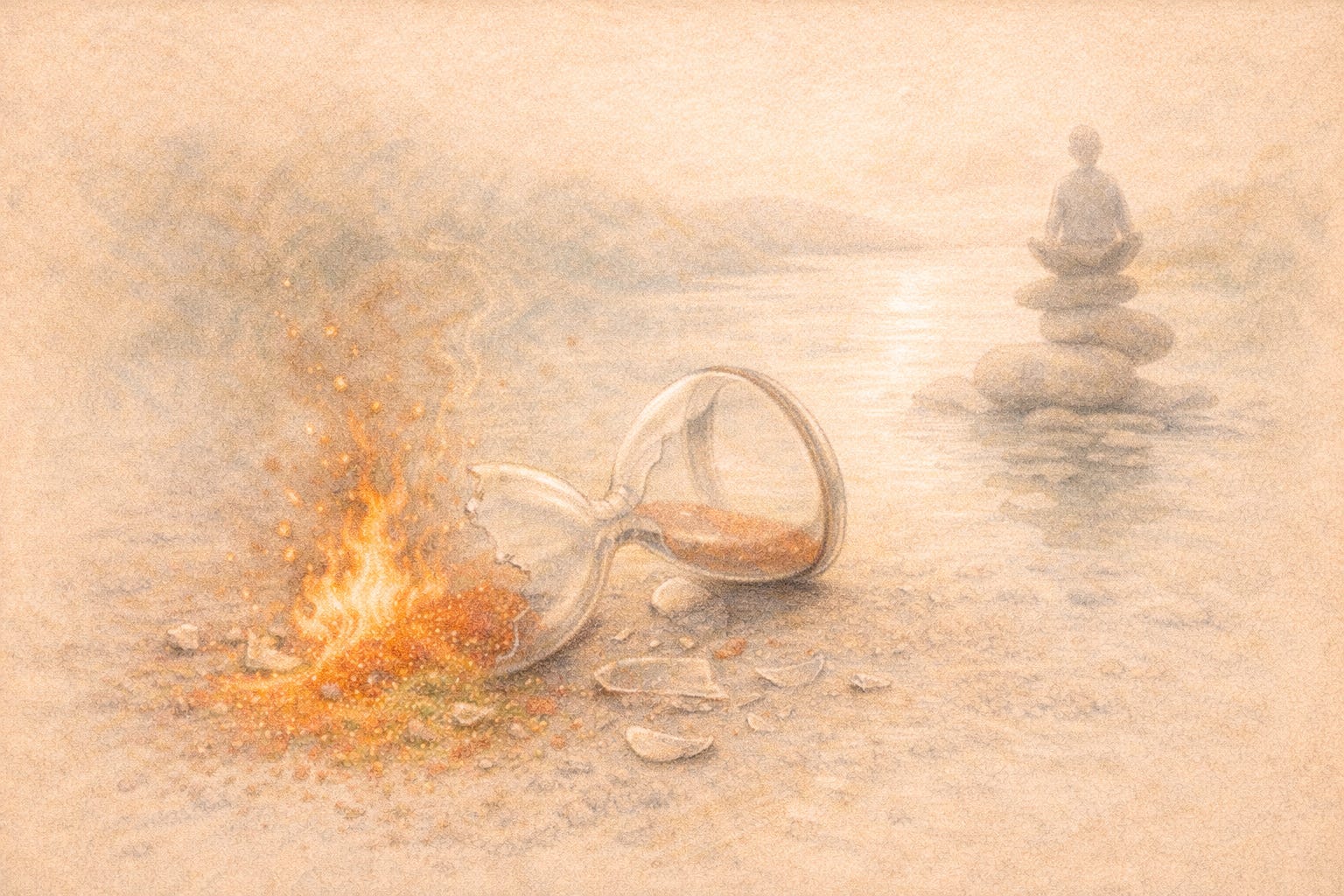
I didn’t come across this quote in a dramatic, life-altering way. No quiet mountain retreat. No perfectly timed podcast episode that stopped me in my tracks.
It was actually a very ordinary afternoon.
A friend and I were sitting across from each other, the kind of conversation that starts normal but slowly shifts tone without you noticing at first. You know those moments - where something subtle changes in the air.
She said something that caught me off guard. Not aggressive, not even intentionally hurtful, but it landed in a way that felt personal. It touched something sensitive in me.
And instead of pausing, I reacted.
Quickly.
I interrupted. I defended myself. My tone changed, sharper than I intended. There was a tightness in my chest, and suddenly I wasn’t listening anymore - I was preparing my next point.
To be fair, I thought I was just being honest. Standing my ground. Explaining myself.
But honestly, I wasn’t responding.
I was reacting.
And within minutes, the conversation shifted from understanding to tension. From connection to distance.
By the end of it, the original issue we were discussing barely mattered. What stayed was how we spoke to each other.
By the time we stopped talking, there was distance between us. And that kind of distance stays with you longer.
How It Actually Unfolded
Here’s what really happened, without trying to make it sound better than it was.
She shared something about how she felt I hadn’t been fully present lately. That I seemed distracted, a bit distant.
If I had paused, I might have heard concern. Or care.
But in that moment, I heard criticism.
And something in me tightened.
My reaction came almost instantly: “That’s not fair. I’ve had a lot going on.”
My voice wasn’t loud, but it carried an edge. You could feel it.
She responded, a bit more guarded now. Then I pushed again. Then she did.
And just like that, we were no longer talking about what mattered. We were talking at each other.
Trying to prove points. Protect ourselves. Win something that didn’t need to be won.
It escalated in small ways - a tone here, a word choice there, a subtle withdrawal. Nothing dramatic on the surface, but underneath, it was building.
By the time we stopped talking, there was distance between us.
Not because of the original issue.
But because of how we handled it.
The problem wasn’t the problem anymore. My reaction was.
It Was Never Just About The Problem
Here’s the thing we don’t always admit.
Life is full of problems. Small ones, big ones, inconvenient ones that show up at the worst possible time. That part is unavoidable. It’s just… life doing what life does.
But what we do with those problems - that’s where things get interesting.
And sometimes, a little uncomfortable.
Because if I’m honest, a lot of the stress I’ve experienced hasn’t come directly from the original issue. It’s come from how I reacted to it. The story I told myself. The speed at which I jumped to conclusions. The way I let one moment spill into ten others.
You’ve probably seen this play out too.
Something small happens. A delay. A misunderstanding. A mistake. And suddenly it becomes something much bigger. Not because it was bigger, but because it grew through reaction.
It’s like taking a spark and turning it into a fire without even realizing you’re the one holding the fuel.
And I don’t say this with judgment. I say it with recognition.
Most of us were never really taught how to respond. We were taught how to react quickly, defend ourselves, fix things fast, avoid discomfort. And in some ways, that makes sense. Reaction feels immediate. It feels like control. But it’s not the same as clarity.
What I Didn’t See In The Moment
In the moment, it felt justified.
That’s the tricky part.
Reactions often feel right when they’re happening. They feel like truth. Like protection. Like standing up for yourself.
But they’re usually fast, emotional, and incomplete.
I didn’t pause long enough to ask:
What is she actually trying to say?
Is this really an attack, or is it something else?
What would it look like to respond instead of defend?
If I had slowed down, even slightly, I might have noticed something important.
She wasn’t attacking me. She was trying to reach me.
But I couldn’t see that, because I was too busy reacting to what I thought was happening.
The Same Pattern Shows Up At Work Too
This doesn’t just happen in personal relationships.
Years ago, I saw the same pattern play out at work
A colleague once questioned a piece of work I had spent a lot of time on. Not harshly, but directly.
And again, that familiar feeling showed up.
That small internal voice: they don’t see the effort… this isn’t fair.
I reacted quickly. Explained myself. Over-explained, actually. There was a slight defensiveness in my tone, even though I tried to keep it professional.
The conversation became tense.
Not openly confrontational, but you could feel it.
Later, when I stepped back, I realized something uncomfortable.
They weren’t criticising me as a person. They were trying to improve the work.
But my reaction turned a collaborative moment into a guarded one.
Looking back, the work itself wasn’t the issue. It was the tension I added to it.
The Space We Keep Missing
That quote about the space between stimulus and response sounds simple. Almost too simple. But in real life, that space is easy to miss. Because it doesn’t feel like a “space.” It feels like a split second.
A moment where emotion rises quickly - faster than logic, faster than clarity. And if we’re not aware, we move with it automatically.
That’s the reaction.
But if we do catch it - even briefly - something changes.
We might still feel the emotion. The discomfort doesn’t disappear.
But we don’t let it fully take over. We give ourselves a chance to choose.
What A Different Response Could Have Looked Like
I’ve thought about that conversation with my friend more than once.
Not in a regretful way, but in a reflective one.
If I could go back, I wouldn’t try to be perfect.
I would just slow down.
Maybe respond like this:
“I didn’t realise it came across that way. Can you tell me more?”
That’s it. Not defensive. Not dismissive. Just open.
That one sentence could have changed everything.
It would have kept the conversation grounded. It would have shown that I was listening, not reacting.
And most importantly, it would have kept the problem where it belonged - small, manageable, real.
Why We Make Problems Bigger Than They Are
Most people don’t mean to escalate situations.
We’re not trying to create more problems. But we do it without noticing. Because reacting feels immediate. It feels like we’re handling things. But often, we’re just adding layers.
Emotion on top of situation.
Assumption on top of reality.
Tension on top of something that could have stayed simple.
And over time, those layers build something heavier than the original issue ever was.
One reaction that deserves its own conversation is anger. It has a remarkable way of convincing us that immediate action is the right action, when in reality it often pulls us further from the outcome we want. Practical Stoic Advice explored this more deeply in What Anger Gives—and What It Takes, where he reflects on both the protection anger seems to offer and the hidden cost it often leaves behind.
Why We Resist The Pause
If pausing is so helpful, why don’t we do it more often?
Honestly, because reacting feels easier.
It gives a sense of immediate action. It feels like we’re doing something. Fixing something. Protecting ourselves.
Pausing, on the other hand, can feel uncomfortable.
It asks us to sit with uncertainty for a moment. To not rush into a conclusion. To admit we might not fully understand what’s happening yet.
And that takes a different kind of strength.
It’s quieter. Less visible. But more powerful.
Also, there’s a part of us that’s used to reacting. It’s a habit. A well-practiced pattern.
Breaking that pattern doesn’t happen overnight.
But it can start with something very small.
The Quiet Challenge In All Of This
So here’s the uncomfortable but honest question this brings:
In how many situations is the real problem not what happened, but how I reacted to it?
Not in a blaming way. In a clarifying way.
Because if we can see that, even occasionally, we start to take back a bit of control.
Not over everything that happens.
But over how much we add to it.
What Problems Are Trying To Teach Us
Once you create that space, something else becomes possible.
You start to see the problem differently.
Instead of just asking, how do I fix this?, another question appears - quieter, but more useful.
What is this showing me?
That question shifts everything.
Because now, the problem isn’t just an obstacle. It’s information.
Maybe it’s showing you where your patience is thin.
Maybe it’s revealing a habit you didn’t realize you had.
Maybe it’s pointing to something deeper - a belief, a fear, a pattern that keeps repeating.
Not every problem comes with a neat lesson attached. But many of them carry something we can learn, if we’re willing to look.
And that willingness often starts with slowing down.
One Small Way I’m Trying To Practice This
I’m not perfect at this. Not even close.
But I’ve started doing something simple.
When I feel that initial reaction rising - that quick emotional surge - I try to delay my response.
Just slightly. Sometimes it’s a breath. Sometimes it’s choosing not to reply immediately. Sometimes it’s asking a question instead of making a statement.
And that small shift changes more than I expected.
Because in that pause, I often realise:
This isn’t as big as it feels right now.
Or even more importantly:
I don’t need to make it bigger.
Why This Matters More Than We Think
This isn’t just about avoiding arguments or staying calm.
It’s about protecting the things that matter.
Our relationships.
Our work.
Our peace of mind.
Our health.
Because when reactions take over, they don’t just affect the moment.
They ripple outward.
They shape how people experience us.
They shape how we experience ourselves.
And over time, they either build connection or slowly create distance.
Your Turn To Reflect
Let me ask you something, honestly.
Think about the last time a conversation didn’t go the way you wanted.
Maybe with a friend. A colleague. Someone close to you.
What actually caused the tension?
Was it the original issue?
Or was it what happened after - the tone, the words, the reaction?
And if that same moment happened again…
What would it look like to pause, even briefly, and respond instead?
Not perfectly.
Just differently.
Because sometimes, that small shift is the difference between a problem staying small and becoming something much heavier than it ever needed to be.
Continue Your Journey with Wisdom Library
Explore further through a carefully curated collection of related articles.
Become part of the Wisdom Library community and start receiving exclusive content.
Go beyond and discover Premium Content designed to inspire deeper experience.
Not ready for a monthly membership? Visit the Wisdom Library Shop and purchase individual premium content whenever something speaks to you.
Browse a thoughtfully curated collection of products chosen to support your journey of growth and everyday life.
If this article meant something to you, buying me a coffee is a simple way to support my work. Every contribution helps Wisdom Library continue to grow. Thank you for being here. 💛
This was so beautiful! I so appreciated your ability to be so transparent and use very personal situations to help the readers understand the message. It really helped to bring it home to the heart! Thank you so much! 😊
Great article , brings up so many interesting and important points and perspectives. I find if I can manage not to take what they say personally (and yes that can be difficult) and just hear the words I can understand it’s about something more and not a personal attack. That foundation keeps me rooted in words not blame .
Therefore my reaction is less of an attack 🧡